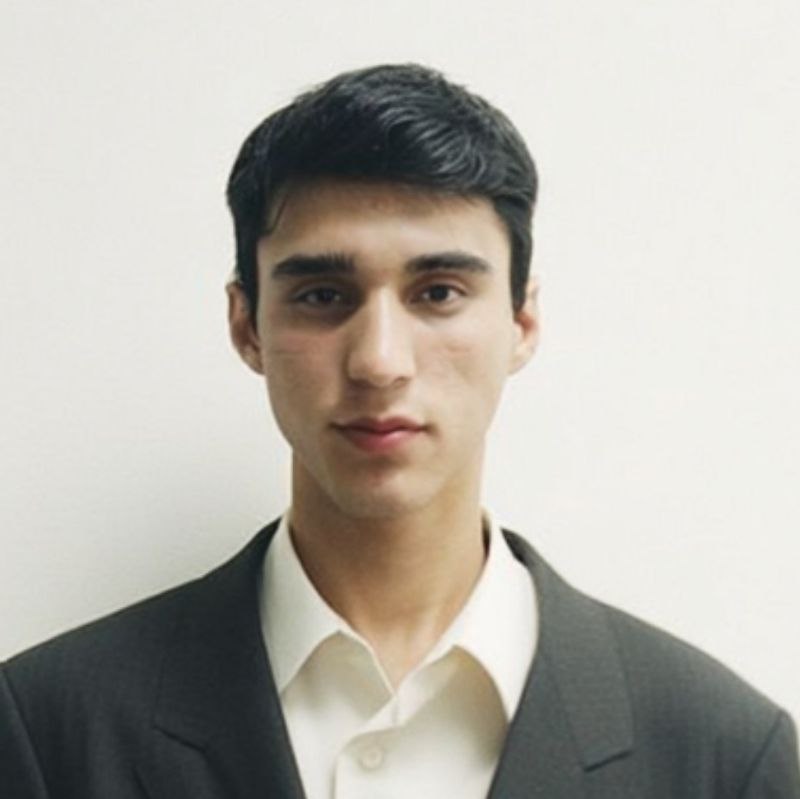
Muhammad
Tojiddinov
Data & AI Engineer · Age 17 · Uzbekistan
At 17, Muhammad has already won a $50,000 Presidential Tech Award, earned certificates from Duke, Google, IBM and the UN, and published research spanning neuroscience, cryptography, and artificial intelligence.

Born curious,
built for discovery.
Muhammad Tojiddinov was born on July 31, 2008 in Uchqo'rg'on, Namangan — a small city in Uzbekistan. From childhood, he was obsessed with a single question: how does the world actually work?
By age 12, he was already writing his first scientific articles. By 15, he had built an AI-powered cybersecurity system sophisticated enough to win a national competition and a $50,000 Presidential Tech Award — making him one of the youngest recipients in Uzbekistan's history.
Today, Muhammad operates at the intersection of neuroscience, artificial intelligence, and philosophy. He researches questions most researchers haven't dared to ask yet — like whether consciousness can be replicated digitally, or how AI might recursively improve itself beyond human benchmarks.
His work is published on TMB Articles and read by over 10,000 people across 14 regions. His ultimate goal: to study at MIT and push the frontiers of what is humanly — and artificially — possible.
Personal Info
Built, not just
theorized.
IqroAI
Adaptive Learning Platform
An AI-powered educational platform that generates personalized lesson plans for each student — aimed at increasing educational engagement across Uzbekistan.
Aisha AI
Personal AI Assistant
A multilingual AI assistant covering conversational support, study guidance, and creative tools — designed for youth productivity and cultural education.
PCP
Cybersecurity System
An AI-based protection system using facial and voice recognition analysis. This project won 2nd place at the Presidential Tech Award competition.
EC Algorithm
Cryptographic Encryption Method
Author of a cryptographic algorithm presented as one of the world's most powerful encryption methods — combining mathematical depth with practical security.
Questions no one
dares to ask.
Self-Improving AI Theory
Parallel trajectories of human and artificial intelligence development — exploring emergent behavior and recursive self-improvement.
The Problem of Consciousness & Its Replication
Can consciousness be digitally duplicated? An investigation into the philosophical and neuroscientific boundaries of the mind.
Ecological Monitoring Systems
AI-driven environmental surveillance frameworks for real-time climate and ecosystem data analysis.
Trained by the
world's best.
Speaking across
borders.
Tools of a
modern scientist.
When not
researching.
My goal is to enter MIT and create discoveries for humanity. By researching at the intersection of neuroscience, artificial intelligence, and philosophy, I want to expand the boundaries of what we know about consciousness, cognition, and technology.
— Muhammad Tojiddinov